

A persuasive grant needs statement does more than prove that a problem exists. It defines who is affected, shows how serious the condition is, explains why it persists, and establishes why action is necessary now.
Reviewers use this section to decide whether the proposed project responds to a documented community priority or merely reflects an applicant’s preference. Strong needs statements combine reliable numbers with local knowledge. They distinguish symptoms from causes, avoid exaggeration, and create a logical bridge to the activities and outcomes described later in the application.
This guide explains how to assemble evidence, interpret it responsibly, involve affected people, write a focused argument, and test whether the final section supports the rest of the proposal.
Understand the job of a needs statement
The needs statement establishes the conditions that justify the project. It should leave a reviewer able to answer five questions: Who experiences the need? What exactly is happening? How large or severe is it? Why are existing responses insufficient? What would happen if the gap continued?
It is not a general history of the organization, a catalog of everything wrong in a community, or an early version of the project plan. Organizational experience belongs in the capacity section. Detailed activities belong in the work plan. The needs section earns the right to propose those activities by presenting a disciplined account of the problem.
Start with the funder’s purpose and scoring criteria
Read the notice before collecting evidence. Funders often define priority populations, eligible geographies, required indicators, or specific conditions they intend to address. A technically impressive needs statement can still score poorly when it answers a broader or different question.
Copy each relevant instruction into a working outline. Note the page limit, review criteria, required data periods, definitions, and any demand for disaggregated information. If the score emphasizes disparity, comparison data will matter. If it emphasizes access, describe capacity, distance, cost, wait time, language, or other barriers. Let the criteria shape the evidence search without forcing the facts into a predetermined conclusion.
Define the population and place precisely
Vague phrases such as “underserved residents” or “local youth” conceal important differences. Define the intended population using characteristics relevant to the opportunity: age range, service area, income threshold, enrollment status, disability, industry, housing situation, or another defensible boundary.
Use one geographic definition consistently. A service area may follow county lines, school districts, neighborhoods, tribal lands, hospital catchments, or travel-time boundaries. Explain why the boundary fits the project. Avoid moving between city, county, and state statistics as if they describe the same group.
Record a denominator whenever possible. Saying that 480 households sought assistance has little meaning without knowing whether the eligible population includes 700 households or 70,000. Rates, percentages, and comparable denominators help reviewers interpret scale.
Write a one-sentence working problem definition
Before researching, draft a neutral sentence in this form: “Among [population] in [place], [condition] occurs at [measurable level], contributing to [consequence].” Treat it as a hypothesis to test rather than a conclusion to defend.
For example: “Among adults in the county’s three northern townships, limited evening transportation contributes to missed health appointments and delayed care.” This sentence identifies a population, location, condition, and consequence. Research may confirm it, narrow it, or reveal that cost and provider schedules matter more than transportation. Revising the definition in response to evidence is a strength.

Build an evidence inventory
Create a source table before drafting. For every fact, record the measure, population, geography, period, source organization, publication date, and limitations. Add a column explaining how the fact supports the argument. This prevents orphan statistics from accumulating simply because they sound alarming.
A balanced inventory usually includes:
- Population data: size, age, income, language, disability, employment, housing, or other relevant characteristics.
- Condition data: rates, counts, trends, wait lists, incidents, test results, or unmet requests.
- Service data: available providers, capacity, utilization, travel time, cost, hours, completion, and referrals.
- Comparison data: similar communities, state or national benchmarks, or internal targets.
- Community evidence: interviews, focus groups, surveys, public meetings, observations, and partner records.
- Consequences: documented effects on health, learning, employment, safety, stability, or another priority outcome.
Mark which sources are primary, which repeat another source, and which rely on estimates. Give preference to authoritative, current, directly relevant data. Older information may still be useful when it is the best available, but state the period and avoid presenting it as current.
Use numbers that answer a question
Every statistic should perform a clear job. One number may establish size, another show a trend, and another reveal a disparity. A paragraph packed with unrelated figures can look researched while leaving the reviewer unsure what matters.
Introduce the claim, present the evidence, and interpret it. Instead of writing “The county poverty rate is 18 percent,” explain what comparison makes that rate meaningful and how it affects the issue. If the rate is concentrated in particular areas or groups, disaggregate it. If the measure is not directly connected to the project, remove it.
Do not confuse correlation with cause. A community may have both high housing costs and school absenteeism, but those facts alone do not prove that one causes the other. Use research, local interviews, or service records to explain the relationship and acknowledge uncertainty where it remains.
Combine scale, trend, disparity, and lived experience
A strong evidence pattern often has four layers. Scale shows how many people are affected. Trend shows whether the condition is improving, stable, or worsening. Disparity shows whether some groups experience the condition differently. Lived experience explains how the problem appears in daily life and why existing options fail.
No single layer is sufficient. A moving story cannot show prevalence. A countywide average can hide a neighborhood crisis. A sharp one-year increase may reflect a reporting change rather than a lasting trend. Combining different forms of evidence produces a more accurate picture and helps reviewers see both magnitude and meaning.
Collect community input ethically
People affected by a problem are sources of expertise, not decorative quotations. Ask them what barriers they encounter, what they already do to address them, which services feel usable, and what a better result would look like. Compensate participants when appropriate, make participation accessible, protect privacy, and explain how their input will be used.
Use a consistent interview or discussion guide so themes can be compared. Record the number and type of participants and how they were recruited. Do not imply that a small convenience group represents an entire population. Describe it honestly as qualitative evidence that adds context to broader data.
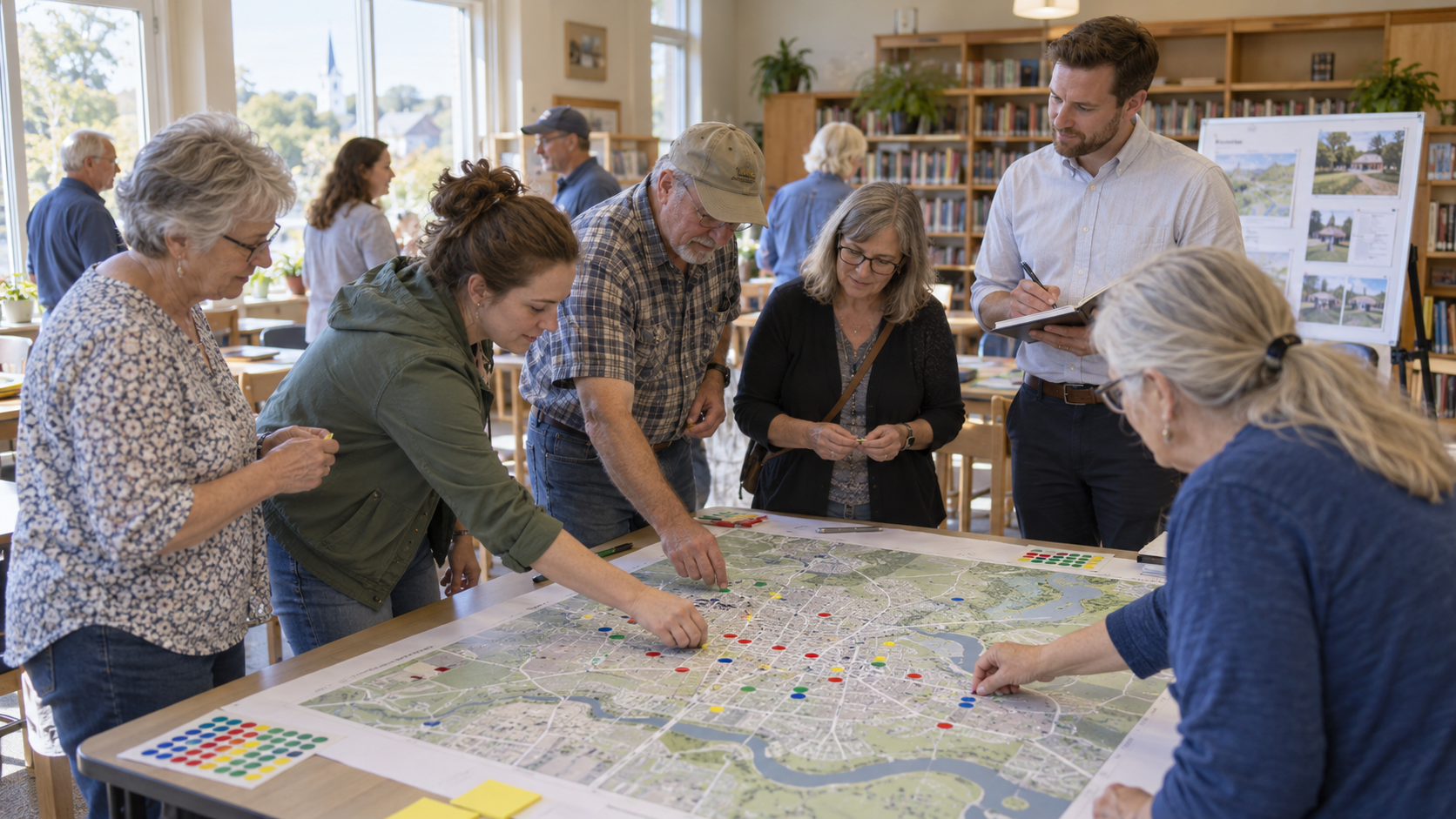
Map assets as well as gaps
Deficit-only descriptions can misrepresent communities and weaken project design. Identify trusted organizations, informal networks, facilities, cultural knowledge, volunteers, transportation routes, existing programs, and other assets that can support change.
An asset does not erase a need. It shows what the project can build upon. A neighborhood may lack affordable after-school capacity while having strong parent networks and available library space. Naming both conditions leads naturally to a more credible response than portraying the community as passive or broken.
Separate the problem from the service gap
The underlying condition and the absence of a particular program are not the same. “Our organization lacks funding for a coordinator” describes an organizational resource gap. It does not yet establish a community need. The needs statement should first document the condition experienced by the population, then explain how current systems respond and where their capacity or design falls short.
Measure the gap directly when possible. Compare demand with available slots, eligible people with participants, referrals with completed appointments, or required coverage with staffed hours. Explain whether the constraint is quantity, accessibility, quality, coordination, awareness, eligibility, or trust. Different gaps call for different solutions.
Analyze root causes without oversimplifying
Use a cause map to distinguish immediate barriers from deeper conditions. For missed appointments, an immediate barrier might be unavailable transportation. Contributing conditions could include dispersed housing, limited transit hours, inflexible work schedules, and a shortage of nearby providers. The proposal may address only some of these causes, and the needs statement should be honest about that scope.
Avoid blaming individuals for structural constraints or describing a complex issue as the result of one behavior. Also avoid claiming that a modest project will solve every cause. Define the portion of the problem the project can reasonably influence and connect it to measurable outcomes.
Explain why current responses are insufficient
Reviewers may know that other services exist. Acknowledge them. Describe what they provide, whom they reach, and where the remaining gap occurs. Evidence may include wait lists, geographic coverage, eligibility rules, language access, operating hours, cost, referral completion, or participant feedback.
Do not criticize partners to make the proposed program appear necessary. Frame the gap as a system condition that the project can help address. If the new effort coordinates or expands existing work, say how it complements those services and avoids duplication.
Create a clear narrative arc
A useful structure moves from broad context to a specific, actionable gap:
- Define the population and place.
- State the central condition and its scale.
- Show the relevant trend or disparity.
- Explain causes and consequences.
- Describe current assets and responses.
- Document the remaining service or system gap.
- Conclude with the need for a bounded response.
Use topic sentences so a reviewer can follow the argument quickly. Put the most important finding early. Reserve secondary detail for later paragraphs or a table if the application allows one.
Keep the need distinct from the proposed solution
Avoid writing the section backward from a favorite activity. If every paragraph appears designed to prove that the organization must purchase a specific tool or hire a particular position, the analysis may feel predetermined. Establish the need independently, then introduce the solution in the project-design section.
The closing paragraph can identify the type of response required without presenting a complete work plan. For example, evidence may support a coordinated evening access strategy rather than declaring that one particular vehicle route is the only answer.
Use precise, respectful language
Choose language that describes conditions instead of defining people by them. Avoid sensational adjectives, unsupported superlatives, and claims that a community has “nothing.” State what the evidence shows. When terminology is contested or identity-specific, follow the preferences of the people described and any relevant funder guidance.
Precision also means preserving the limits of the data. Say “survey respondents” when a result comes from respondents, not “all residents.” Say “reported incidents” when unreported events may exist. Confidence grows when the writer shows command of what a source can and cannot support.
Align the needs statement with the rest of the proposal
Create a traceability check. Each major need should connect to at least one objective. Each objective should have activities capable of changing the relevant condition. Evaluation measures should test that change, and the budget should fund the required work.
If the needs section emphasizes rural transportation but the work plan focuses mainly on health education, the logic breaks. If the evidence concerns high school students but the participant target includes all ages, the population has drifted. Fix these inconsistencies before polishing sentences.
Common mistakes to remove
- Opening with several pages of national background before defining the local need.
- Using statistics from different geographies or periods without explaining the mismatch.
- Listing numbers without interpreting what they mean.
- Treating one anecdote as proof of prevalence.
- Ignoring existing services and community assets.
- Describing the organization’s funding shortage as the community problem.
- Claiming causation that the evidence does not establish.
- Using stigmatizing language or portraying participants only through deficits.
- Proposing activities before the gap has been demonstrated.
- Failing to connect the documented need to objectives and evaluation measures.
Conduct a source and logic audit
Highlight every factual claim and confirm that it has a reliable source or is clearly identified as local observation. Check names, dates, denominators, geography, and calculations against the original material. Remove citations you have not personally verified. Make sure paraphrases preserve the source’s meaning.
Then read only the first sentence of each paragraph. Those sentences should form a coherent argument. Ask a colleague unfamiliar with the project to summarize the need, population, causes, gap, and urgency. If the summary differs from your intent, revise the structure before editing for style.
A practical final checklist
- The population and geography are specific and consistent.
- The central problem can be stated in one clear sentence.
- Evidence demonstrates scale and includes an appropriate comparison.
- Sources are current, authoritative, and accurately represented.
- Community input adds context without being overstated.
- Assets, existing services, and remaining gaps are all described.
- Root causes are distinguished from symptoms.
- The language is precise, respectful, and free of exaggeration.
- The proposed objectives follow directly from the documented need.
- Every important claim survives a source and logic check.
Make the case, then stop
Frequently asked questions about needs statements
How recent should the data be?
Use the newest reliable data that matches the population and geography, but do not reject an older source automatically. Some authoritative surveys, health indicators, or local studies are released on long cycles. State the collection period, look for a newer corroborating indicator, and explain any event that may have changed the condition since then. A current but poorly matched statistic is not necessarily better than a slightly older measure of the exact population.
How many statistics should the section include?
There is no ideal number. Include enough evidence to establish scale, comparison, trend, disparity, causes, and the service gap without repeating the same point. Three well-chosen measures with clear interpretation often do more work than fifteen disconnected figures. When space is tight, prioritize facts that directly shape the project and remove background information a reviewer does not need to judge the response.
Can organizational records be used?
Yes. Intake records, wait lists, referral logs, attendance, service requests, and completion data can show conditions that public datasets miss. Explain who is included, the time period, how the information was collected, and whether the records represent the whole community or only people who contacted the organization. Pair internal data with an external source when possible so the reviewer can understand both the local detail and the broader context.
What if no dataset covers the exact service area?
Use the closest defensible sources and describe the limitation openly. You may combine administrative records, smaller-area estimates, partner data, observation, and structured community input. Do not invent precision by applying a county rate mechanically to a neighborhood. Explain why the available evidence is relevant, what remains unknown, and whether the project will improve local measurement as part of implementation.
Should the needs statement include citations?
Follow the application instructions. If no format is required, use a consistent, compact method that lets a reviewer identify the source and period. A short parenthetical reference and a source list may work better than long footnotes in a page-limited narrative. Whatever the format, verify every citation against the original source and make sure the cited material actually supports the sentence.
How should qualitative evidence be presented?
Describe the method before reporting the theme. State how many people participated, who they were, how they were recruited, and when the conversations occurred. Summarize recurring patterns and include a brief quotation only when consent and privacy practices allow it. Do not use a vivid statement to imply prevalence. Qualitative evidence is strongest when it explains mechanisms, experiences, preferences, and barriers alongside quantitative measures.
How can urgency be shown without exaggeration?
Use a trend, approaching policy change, documented capacity loss, growing wait list, seasonal deadline, or consequence of continued delay. Explain why action during the proposed period matters. Avoid words such as “catastrophic,” “unprecedented,” or “desperate” unless a reliable source and the facts justify them. Reviewers tend to trust a measured explanation that shows practical consequences and a realistic window for action.
What if the funder already understands the issue?
Do not spend scarce space teaching the funder its own field. Establish the specific local expression of the problem and the gap your project addresses. Use national context only when it helps interpret local results or shows an important disparity. The reviewer still needs enough evidence to compare your proposal with others, but specificity will usually distinguish the application better than a long overview.
Can one needs statement support several objectives?
Yes, when the objectives respond to related dimensions of one clearly defined problem. Create a small logic table linking each documented condition to an objective, activity, and indicator. If an objective cannot be traced back to evidence, either add the missing analysis or remove the objective. If the section contains several unrelated needs, the proposal may require a narrower scope rather than more data.
When is the needs statement ready?
It is ready when an informed outsider can identify the population, place, condition, scale, causes, consequences, assets, existing response, and remaining gap without guessing. Every material fact should be traceable, and every proposed objective should follow logically. Final polish matters, but no amount of elegant language can substitute for a coherent definition and evidence that fits it.
The best needs statement is not necessarily the longest. It is the one in which every paragraph helps the reviewer understand the population, condition, causes, consequences, assets, and remaining gap. Strong evidence and careful interpretation create urgency without drama.
When that foundation is sound, the rest of the proposal becomes easier to assess. The project can be judged against a clearly defined problem, the outcomes can measure meaningful change, and the budget can be understood as the cost of a credible response.
