

A grant logic model is a compact explanation of how a project is supposed to create change. It connects the resources an organization will invest, the work it will perform, the people it will reach, and the results it expects to achieve. A theory of change goes one level deeper: it explains why those connections are reasonable and what must be true for the chain to hold.
Together, these tools help a team move beyond a list of activities. They expose gaps before a proposal is submitted, create a shared definition of success, and give evaluators a practical basis for judging whether the project is credible. The most useful models are specific enough to guide decisions and simple enough that staff, partners, and reviewers can understand them without a separate instruction manual.
Start with the decision the model must support
Do not begin by filling boxes. Begin by identifying the decision the model needs to support. A proposal-stage model may need to demonstrate that a service design is plausible. A start-up model may need to coordinate several partners. A mature program may need to clarify which activities contribute most to long-term outcomes. The purpose determines the right level of detail.
Name the primary audience as well. A funder may want a one-page overview, while the delivery team needs a more detailed working version. Build the detailed model first, then create a concise presentation version. Trying to make one diagram serve every audience usually produces either a vague picture or an unreadable wall of text.
Define the problem with evidence and boundaries
A strong model begins with a precise problem statement. Describe who experiences the condition, where it occurs, how large it is, and what evidence supports the claim. Separate the immediate condition from its causes. For example, low participation in preventive care is a condition; transportation, scheduling, trust, language access, and cost may be contributing factors.
Set boundaries around what the project can reasonably influence. A neighborhood initiative may improve access and service use without eliminating every structural cause of poor health. This boundary protects the model from exaggerated claims. It also helps the team choose outcomes that can be measured within the grant period.
Write the long-term result before choosing activities
State the durable change the project is working toward in plain language. Then work backward. Ask what medium-term behaviors, practices, or conditions would need to change first. Next ask what participants must learn, receive, believe, or be able to do. This backward sequence keeps the model focused on results rather than existing programs.
A useful long-term result identifies the population and the desired condition but does not promise what the project cannot control. “More older adults in the county remain safely housed” is more defensible than “end senior homelessness.” The result can be ambitious while the proposal remains candid about its contribution.
Map the five core parts of a logic model
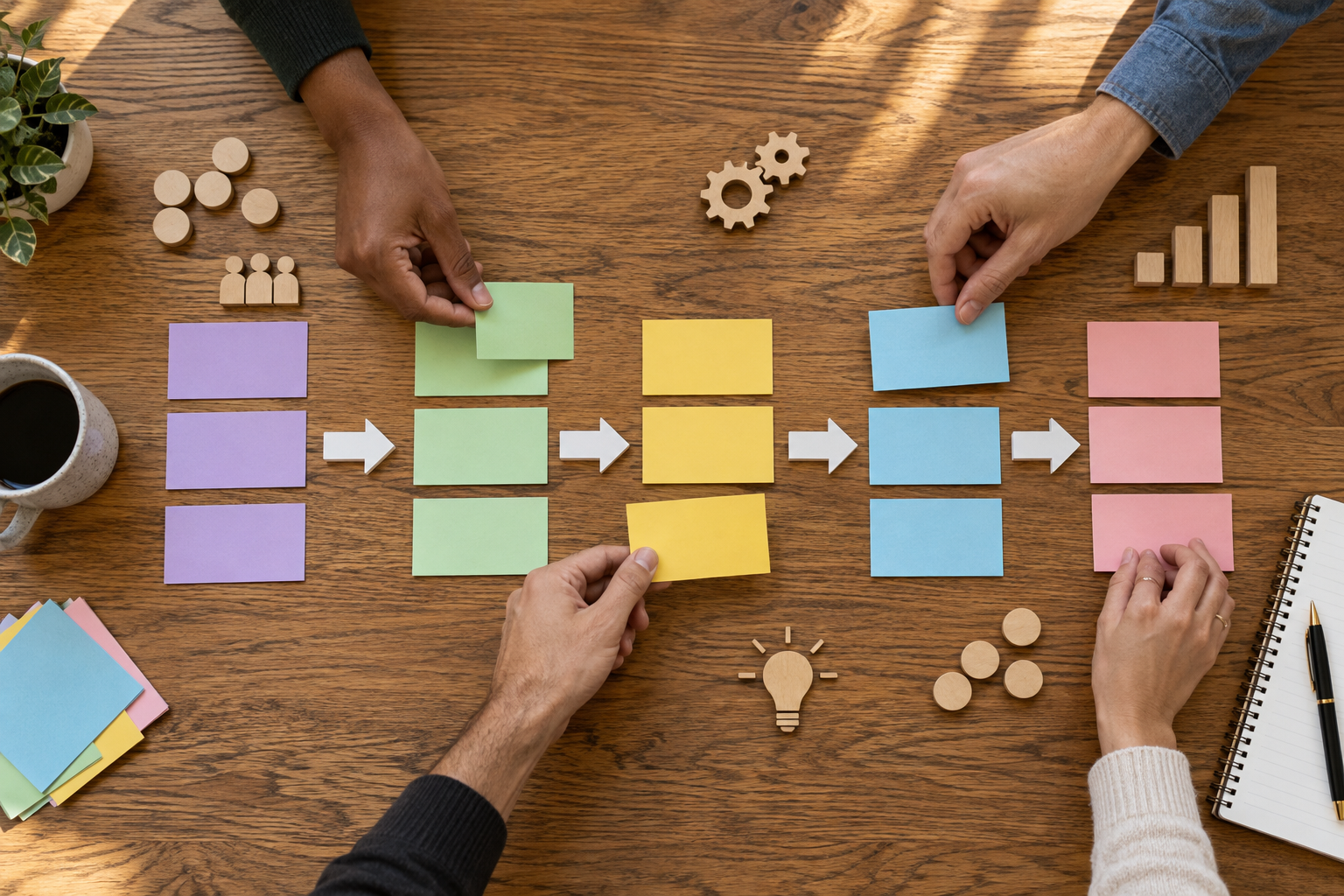
Most logic models contain five linked parts:
- Inputs: staff time, facilities, technology, partnerships, funding, expertise, and other resources.
- Activities: the services, training, outreach, coordination, or production the project will conduct.
- Outputs: direct counts of what the activities produce, such as sessions delivered, people enrolled, or plans completed.
- Short- and medium-term outcomes: changes in knowledge, access, behavior, practice, or institutional performance.
- Long-term outcomes: broader conditions the project expects to influence over time.
Each item should be concrete. “Community engagement” is too broad to function as an activity. “Conduct six resident design sessions and publish a response summary” can be scheduled, budgeted, and verified. Likewise, “program success” is not an outcome until the team defines the observable change that would count as success.
Keep outputs and outcomes separate
Outputs describe volume. Outcomes describe change. A workshop, referral, assessment, or resource guide is an output. Greater knowledge, successful connection to services, improved practice, or reduced wait time is an outcome. Confusing the two makes a proposal look busy without showing why the work matters.
Use a simple test: if the measure can rise merely because the team worked harder, it is probably an output. If it requires something to change for participants or systems, it is probably an outcome. Both matter. Outputs show whether the plan was delivered; outcomes show whether delivery made a difference.
Turn the logic model into a theory of change
The arrows between boxes contain the real theory. For every connection, complete the sentence: “If we do this, then this result should follow because…” The answer should name a mechanism supported by experience, evidence, or a credible rationale. Training may improve practice because participants rehearse a skill, receive coaching, and get supervisor reinforcement. A referral platform may improve access because it reduces repeated intake and confirms whether a connection was completed.
Write these explanations outside the diagram as a short narrative. A reviewer should be able to see why the proposed activity fits the stated barrier. If the only rationale is that the organization has always offered the activity, the team has not yet established a theory of change.
Identify assumptions explicitly
Assumptions are conditions the project relies on but may not fully control. Participants may need transportation, partners may need to share data, employers may need to recognize a credential, or families may need access to child care. Hidden assumptions become operational surprises.
For each major link, list the assumptions and decide what to do with them. Some can be tested before launch. Some can be strengthened through a partner agreement or contingency budget. Others should become monitored risks. An honest assumption does not weaken a proposal; it shows that the team understands how implementation works in the real world.
Add external factors without surrendering accountability
External factors include policy changes, labor-market conditions, weather, public health events, housing supply, and other forces outside the project. Record the factors most likely to affect results, then specify how the team will recognize and respond to them. Avoid using external conditions as a general excuse for weak performance.
A useful model distinguishes contribution from control. The project owns its service quality, reach, and follow-up. It may only contribute to a regional employment rate or community health trend. That distinction leads to fairer measures and more credible claims.
Build the model with the people closest to the work
A logic model created by one proposal writer often misses practical constraints. Include program staff, finance, data staff, partners, and people with relevant lived experience. Ask each group where the proposed chain is strongest, where it is uncertain, and what resources are missing.
Use a facilitated session in which participants first work independently, then compare their maps. Independent thinking reduces the chance that the most senior person defines the answer too early. The group can then combine ideas, resolve contradictions, and record unresolved questions for follow-up.

Test every arrow in the field
A draft model should be treated as a hypothesis. Walk through the real service environment. Observe how participants enter, where delays occur, who makes decisions, and what happens after a referral or session ends. Compare that experience with the clean sequence on paper.
Field testing often reveals missing activities such as reminders, transportation coordination, language support, supervisor coaching, or data consent. It may also show that an outcome depends on another organization’s action. Revise the model before the grant budget and work plan are finalized, when these discoveries are still inexpensive to address.
Attach indicators to the outcomes
Every priority outcome should have at least one indicator. Define the indicator, population, data source, collection frequency, baseline, target, and responsible person. Prefer a small set of measures that can be collected consistently over a large set that overwhelms staff.
Check whether the indicator actually represents the outcome. Attendance does not prove knowledge gain. Satisfaction does not prove behavior change. A placement is not the same as sustained employment. When direct measurement is impractical, explain the proxy and its limitations.
Check alignment with the budget and work plan
Every meaningful activity requires resources, and every major cost should support an activity in the model. Compare the logic model line by line with the budget and implementation schedule. If the model promises coaching but the budget includes no coaching time, the design is incomplete. If the budget includes expensive software that appears nowhere in the model, the cost may be difficult to justify.
Also check timing. Some outcomes cannot occur until enrollment, service delivery, and follow-up have happened. The measurement schedule should respect that sequence. A realistic model helps prevent targets from being assigned before participants have had enough exposure to the program.
Use the model during implementation
After award, convert the model into a management tool. Review outputs monthly, early outcomes quarterly, and longer-term outcomes at appropriate intervals. When results lag, trace backward through the chain. Was the activity delivered as designed? Did it reach the intended group? Was an assumption false? Did an external factor change?
This approach supports learning without lowering standards. A model can be revised when evidence shows that the pathway is incomplete, but changes should be documented, approved when required, and reflected in the evaluation plan. The record should explain what changed and why.
Common logic model mistakes
- Listing existing programs before defining the result.
- Using broad labels that cannot be scheduled or measured.
- Treating participation counts as proof of impact.
- Skipping assumptions and external factors.
- Claiming control over outcomes far beyond the project’s reach.
- Building a diagram that conflicts with the budget or narrative.
- Creating the model for the application and never using it again.
Examine equity at every step
A model can produce a positive average while leaving some groups behind. Ask who can enter the program, who completes each activity, who receives the intended benefit, and whose experience is missing from the evidence. Barriers may arise through eligibility rules, location, hours, language, technology, disability access, trust, or cost.
Add measures that reveal reach and results across relevant groups while protecting privacy and avoiding unstable conclusions from very small samples. When a difference appears, investigate the process that produced it. Equity should influence the design of activities and resources, not appear only as a final reporting category.
Compare alternative pathways
Teams often commit to the first plausible sequence. Instead, map at least one alternative. Could the result be achieved through direct service, capacity building, policy change, coordination, or a different combination? Compare reach, intensity, evidence, cost, timing, and risk.
This exercise does not require the proposal to fund every option. It demonstrates why the selected pathway is the best fit for the need and the organization’s role. It may also reveal that two participant groups require different pathways rather than one uniform intervention.
Use evidence in proportion to the claim
Support important links with research, local data, prior results, or structured practitioner knowledge. A familiar activity is not automatically effective for a new population or setting. Note where evidence is strong, where it is transferred from another context, and where the project is testing an innovation.
Match the strength of the outcome claim to the strength of the design. A short pilot may reasonably test feasibility, reach, and early change. It usually cannot establish a durable community-level effect. Precise claims make the model more credible.
Plan for scale and sustainability
If the project may expand, identify which elements must remain consistent and which can adapt. Scaling may require new supervision, training, partner capacity, technology, or quality controls. A method that works through one exceptional staff member may fail when delivered across many sites.
Show how lasting outcomes could continue after grant funding. Sustainability may come from institutional policy, a reimbursement stream, trained local staff, shared infrastructure, or reduced unit cost. The model should distinguish continuation of a benefit from continuation of every funded activity.
Set governance for model revisions
Name who maintains the model, who can approve a change, and when the team will review it. Changes to an activity may affect the budget, measures, participant materials, and partner commitments. A controlled review keeps these documents aligned.
Preserve prior versions and a short change log. The log should state what changed, the evidence behind the decision, and any approval obtained from the funder. This turns adaptation into documented learning.
Facilitate disagreement productively
Differences often reveal genuine uncertainty about the project. Ask participants to identify the evidence behind their preferred pathway and the condition that would show it is wrong. Separate questions of mission, evidence, feasibility, and ownership so the group can address the real disagreement.
Record minority views and unresolved assumptions instead of forcing false consensus. Some questions can become pilot tests or evaluation questions. A model is stronger when it represents examined choices rather than the quickest agreement in the room.
A practical final review
Read the model from left to right and ask whether each step is necessary and sufficient. Then read it from right to left and ask what must happen before each result can occur. A person unfamiliar with the project should be able to explain the basic pathway after a short review.
Finally, ask the delivery team whether it would use the model to make a real decision. If the answer is no, simplify it, make its assumptions visible, and connect it to the measures and milestones staff already manage. A strong logic model is not decorative. It is a disciplined promise about how resources will be converted into results and how the organization will learn whether that promise is holding.
