

A grant letter of inquiry, often called an LOI, is a concise case for why a funder should spend more time considering your organization and proposed work. It is not a shortened full proposal. Its purpose is to demonstrate fit, establish credibility, present a focused opportunity, and make a clear request within a small amount of space.
Some funders use LOIs to screen applicants before inviting proposals. Others accept them as the first step in relationship building. In either case, the strongest letters respect the funder’s interests while making the applicant’s distinct value easy to understand.
This guide explains how to research fit, shape the request, organize the letter, write with precision, avoid common mistakes, and prepare for what happens after submission.
Confirm what the funder means by LOI
“Letter of inquiry,” “letter of intent,” “concept note,” and “brief proposal” are sometimes used interchangeably, but they may require different information. Read the instructions closely. A letter of inquiry usually asks whether the funder is interested. A letter of intent may notify a funder that an application is coming. A concept note may require a more developed project design.
Record the required length, format, submission method, attachments, deadline, contact rules, and review timeline. If the funder provides questions or a portal form, answer those prompts in that order instead of forcing the content into a traditional business-letter structure.
Research fit before drafting
An LOI cannot create alignment that does not exist. Review the funder’s stated priorities, geographic limits, eligible applicants, typical award size, grant term, exclusions, and recent awards. Look for patterns in whom the funder supports and what type of work it funds: direct service, systems change, capital, research, capacity, advocacy, or general operations.
Write a private fit statement: “This request fits because…” Complete it with specific evidence. If the sentence depends on stretching the project, changing the population, or using a priority word without changing the work, reconsider the prospect. A disciplined no protects the relationship and saves time.
Decide what you are asking for
Before writing, define the purpose, amount, period, and type of support. A request for $50,000 over one year to expand evening legal clinics is clearer than a general request to “support access to justice.” If the funder has not published a range, use its recent grants and your actual project budget to select a defensible amount.
Know whether the request is for a project, general operations, planning, equipment, capacity, or another purpose. Do not disguise operating support as a project. The amount and purpose should match the funder’s practice, the scale of the need, and the organization’s capacity to deliver.
Define the one idea the letter must convey
A short letter cannot carry every program, need, credential, and future ambition. Decide what the reader should remember after one minute. A useful central message combines the population, problem, response, and expected change.
For example: “A mobile evening clinic will help uninsured workers in three rural towns receive preventive care before treatable conditions become emergencies.” Every paragraph should strengthen that idea. Details that do not improve fit, credibility, or understanding belong elsewhere.
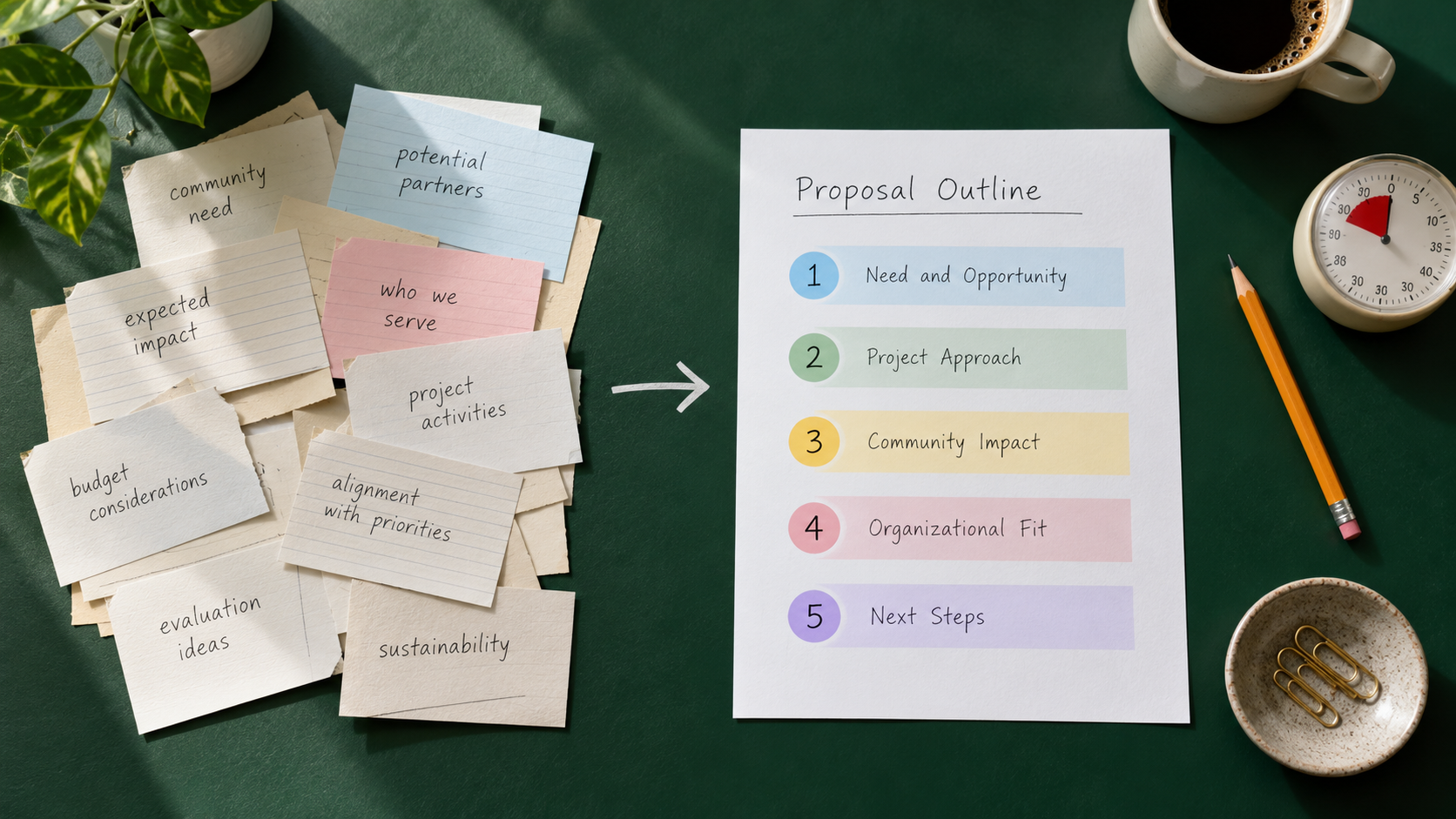
Use a simple structure
Unless the funder specifies another format, a strong LOI usually contains six parts:
- Opening and request: identify the organization, amount, purpose, and connection to the funder.
- Need: define who is affected, the relevant condition, and the evidence.
- Response: explain the central activities and why the approach is appropriate.
- Results: state realistic outputs and outcomes.
- Capacity and resources: show why the organization can deliver and how the request fits the budget.
- Close: invite further conversation and provide the correct contact.
This structure is flexible. The goal is a logical progression, not six labeled blocks. In a portal, distribute the same reasoning across the required fields.
Open with substance
The first paragraph should orient the reader immediately. State the organization, request amount, proposed work, people or place served, and relevant funder connection. Avoid opening with a long history, inspirational quotation, or general claim about a national crisis.
A direct opening might say that a community health organization seeks a one-year award to add evening preventive clinics for uninsured workers in three named towns. The next sentence can connect the work to the funder’s health-access priority. The reader now understands the request and why it arrived.
Present only the evidence needed
The need section should establish scale, urgency, and the service gap without becoming a miniature research report. Use a few well-chosen facts that match the population and geography. Interpret each statistic instead of stacking numbers.
Add local evidence such as wait lists, interviews, partner records, or service trends when it explains what broad datasets cannot. Acknowledge existing services and show the remaining gap. Avoid defining the organization’s funding shortage as the community’s need.
Describe the response at the right level
Explain what the organization will do, for whom, where, and over what period. Identify the mechanism that connects the activities to the desired result. The letter should be concrete enough to judge while leaving detailed schedules and methods for an invited proposal.
Choose two or three defining features rather than listing every task. If partnerships are essential, name their roles. If the project adapts a proven model, explain the relevant adaptation. If it is a pilot, state what will be tested and what decision the results will inform.
State measurable results
Include outputs and outcomes that fit the request. Outputs describe delivery, such as clinics held or people trained. Outcomes describe change, such as improved access, knowledge, stability, or performance. Use credible targets based on capacity and prior experience.
Do not promise to solve a regional problem with a small grant. Define the portion the project can influence and the evidence you will collect. One clear outcome is more persuasive than several sweeping promises.
Show organizational capacity selectively
Choose credentials that reduce the funder’s uncertainty about this work: relevant results, trusted relationships, specialized staff, financial controls, facilities, lived expertise, or experience with the population. A founding date and mission statement rarely prove delivery capacity by themselves.
If the organization is new, emphasize the team’s experience, partnerships, governance, and readiness. If the work is new to an established organization, explain how it grows from current services and strategy. Be candid about what the grant will build.
Explain the money without reproducing a budget
State the total project cost, request amount, grant period, and status of other major support when space allows. Identify the primary uses of funds. This helps the reader judge proportion and feasibility.
Use accurate language for pending and committed revenue. Do not imply that a prospect has committed. If the request is one part of a larger initiative, explain how the pieces fit and whether the project can proceed at a different scale.
Connect to the funder naturally
Demonstrate that the letter was written for this funder by referencing a relevant priority, community, or funding approach. One specific connection is enough. Copying the funder’s language repeatedly can sound mechanical and may obscure the applicant’s own voice.
Do not praise the funder excessively or claim a partnership that does not exist. The best connection is substantive: their interests and your work genuinely intersect.

Write for a reader scanning quickly
Use short paragraphs, active verbs, concrete nouns, and informative first sentences. Replace abstract phrases with observable work. “Staff will conduct twelve evening clinics” communicates more than “The initiative will facilitate a transformation in access.”
Define acronyms once or remove them. Use headings only if the format supports them. Keep numbers consistent and verify every name. A concise letter feels complete because its logic is clear, not because every sentence is compressed.
Build a respectful relationship before and after submission
If the funder welcomes contact, prepare a short, relevant question that is not answered publicly. A conversation may clarify fit, timing, or the appropriate request type. Respect instructions that prohibit calls or unsolicited materials.
After submission, follow the stated process. Do not send repeated status requests. If invited, respond promptly and preserve consistency between the LOI and full proposal. If declined, record what you learned and maintain the relationship when a genuine future fit exists.
Tailor reusable facts without recycling the letter
Maintain an approved fact bank containing mission, service area, current statistics, program results, leadership, financial figures, and standard descriptions. This improves accuracy and speed. The final letter should still be built around the specific funder’s priorities and request.
Do not send a generic letter with a changed name. Duplicate language across prospects can introduce wrong priorities, outdated figures, or inconsistent asks. Tailoring is strategic selection, not cosmetic substitution.
Use a two-stage editing process
First edit for strategy. Check fit, logic, evidence, request size, and consistency. Confirm that each paragraph has a purpose. Then edit for language, length, grammar, formatting, and tone. Polishing a poorly chosen request wastes effort.
Ask one reviewer unfamiliar with the draft to identify the organization, need, response, amount, results, and funder fit. Ask a second reviewer to verify facts and finances. Give the executive signer enough time to approve the actual letter.
Common LOI mistakes
- Submitting despite weak eligibility or priority fit.
- Hiding the request amount until the final paragraph.
- Spending too much space on organizational history.
- Using a broad national problem without local evidence.
- Listing activities without explaining why they will work.
- Promising results far beyond the project scale.
- Calling unconfirmed revenue or partnerships committed.
- Attaching unrequested documents.
- Sending the same letter to multiple funders.
- Ignoring the funder’s page, word, or portal limits.
Submission checklist
- The organization and request are eligible.
- The amount and grant period are explicit.
- The opening establishes fit and purpose.
- The need is supported by relevant evidence.
- The response and expected results are understandable.
- Capacity claims are specific and accurate.
- Financial figures agree with internal records.
- Names, dates, and contact information are correct.
- The letter follows every formatting instruction.
- The authorized signer approved the final version.
Frequently asked questions
How long should an LOI be?
Follow the funder’s limit. When no guidance exists, one to two pages is often enough to establish fit and invite further review. The appropriate length depends on the complexity of the work and requested information. Do not add detail merely to fill space.
Should an LOI include a full budget?
Include a full budget only when requested. Otherwise state the total project cost, request amount, period, primary uses, and major committed or pending support. Keep a detailed internal budget so every summary figure is defensible.
Can the same LOI be sent to several funders?
The underlying facts can be reused, but the request should be tailored. Funders differ in priorities, award sizes, terminology, geography, and preferred role. Review every sentence for fit and remove references that belong to another prospect.
Should the letter include attachments?
Send only required or explicitly welcomed attachments. Unrequested brochures, reports, and videos create work for the reader and may violate the process. Have standard documents ready for an invitation.
Who should sign the letter?
Use the person specified by the funder. Otherwise choose an executive or authorized leader who can stand behind the request. The staff contact may be different from the signer and should be clearly identified.
What if the funder declines?
Record the decision, any feedback, and whether the issue was fit, timing, capacity, competition, or available funds. Ask for feedback only when the funder permits it. Do not resubmit the same concept immediately unless invited.
How soon should a full proposal be ready?
Develop the project design and budget before the LOI so an invitation does not trigger a scramble. You do not need final prose, but leadership, partners, costs, outcomes, and approvals should be sufficiently mature to support the claims already made.
Earn the next conversation
Build an internal LOI planning brief
Before drafting, create a one-page internal brief with the prospect, contact rules, deadline, request amount, project cost, period, population, geography, need, response, outcomes, funder connection, organizational proof, budget status, partners, approvals, and next step. Mark each fact as verified, pending, or assumed.
This brief separates decision-making from prose. Leaders can approve the strategic shape before a writer invests time, and reviewers can see unresolved facts immediately. Preserve the final brief with the submitted letter so a later proposal team knows which assumptions supported the inquiry.
Test the request against three kinds of fit
Programmatic fit asks whether the proposed work advances the funder’s priorities. Institutional fit asks whether your organization and population match its eligibility and giving patterns. Financial fit asks whether the amount, cost structure, and grant term resemble awards the funder can make.
A request can be strong in one dimension and weak in another. A funder may care deeply about the issue but fund only a different region. It may support your population but make awards too small to launch the proposed model. State the evidence for all three before assigning the prospect a high priority.
Develop the letter from a message hierarchy
Rank content as essential, supporting, or optional. Essential content includes the request, fit, need, response, expected result, capacity, and contact. Supporting content may include one partnership, one prior result, or a concise financial fact. Optional content includes history and secondary activities.
Draft the essential layer first. Add supporting details only when they answer a likely reviewer question. When the letter exceeds its limit, remove optional material before shortening evidence or making the request vague. This preserves meaning while reducing length.
Make every paragraph pass a purpose test
Label each paragraph in the margin: request, fit, need, response, result, capacity, finances, or close. If a paragraph has no label, it may not belong. If several paragraphs have the same label, combine them or decide which adds the strongest proof.
Then examine transitions. The need should make the response reasonable; the response should produce the results; capacity should reduce doubts about delivery; and the budget should match the scale. A reader should not have to invent those connections.
Handle different request types honestly
For general operating support, explain the organization’s central work, current priorities, community value, results, and why flexible funds matter. Do not invent a restricted project. For capital, explain the service purpose, readiness, total cost, financing plan, schedule, ownership, and continuing operating effect.
For planning support, name the decision or product the planning period will produce. For capacity building, define the organizational limitation, the improvement, and how it will strengthen mission results. For multi-year support, show what changes across years and how the organization will manage continuation.
Use evidence proportionate to the letter
Keep a source note for every statistic even if formal citations are not required. Use the most relevant geography and period, and avoid percentages without denominators. One local measure, one comparison, and one service-gap indicator may be sufficient.
When space prevents methodological detail, choose plain language that does not overstate precision. The full proposal can explain sources and limitations. The LOI must still avoid claims the underlying evidence cannot support.
Plan for an invitation before pressing submit
Identify the proposal lead, decision-makers, budget owner, partners, data sources, and approval calendar. List what would need to be completed during the invitation window. Resolve major design and cost questions early enough that the full proposal can remain consistent with the LOI.
Save the exact submitted version and any portal responses. When invited, create a comparison table showing each LOI commitment and where it appears in the proposal. If facts change, address the change deliberately rather than allowing the two documents to conflict.
Final sentence-level quality review
- Replace unsupported adjectives with facts.
- Make the actor and action clear in every activity sentence.
- Use the same population, geography, project name, amount, and period throughout.
- Check that each number has a source and correct unit.
- Remove acronyms used only once.
- Delete throat-clearing phrases that delay the point.
- Confirm pronouns have unmistakable referents.
- Read the letter aloud for rhythm and missing words.
- Inspect the final PDF or portal preview, not only the source document.
Example: turning a broad idea into an inquiry
Suppose a neighborhood organization begins with the idea “We need funding for youth.” That statement is too broad to research, budget, or evaluate. The team reviews attendance, school schedules, family interviews, existing recreation, and recent incidents. It defines a specific gap: middle-school students in two apartment communities lack supervised weekday programming during the three hours after school.
The organization then defines a one-year response: four afternoons of small-group arts and homework support at an existing community room, delivered with the library and a teaching-artist partner. It estimates participation, staffing, supplies, transportation, and evaluation. The inquiry asks for one defined share of the total cost and names other committed resources.
The resulting letter does not attempt to describe every youth issue. It establishes the local gap, explains why the chosen time and locations matter, presents an achievable model, names the expected attendance and school-engagement outcomes, and shows that space and partners are ready. The example illustrates the central discipline of an LOI: narrowing a worthwhile mission into a fundable, testable request.
A strong LOI respects the reader’s time. It presents a well-matched request, credible evidence, a focused response, realistic results, and an organization capable of delivery. Its brevity is evidence of disciplined thinking.
The immediate goal is an invitation or useful conversation. Even when the answer is no, a clear and accurate letter protects the organization’s reputation and improves future prospect decisions.
